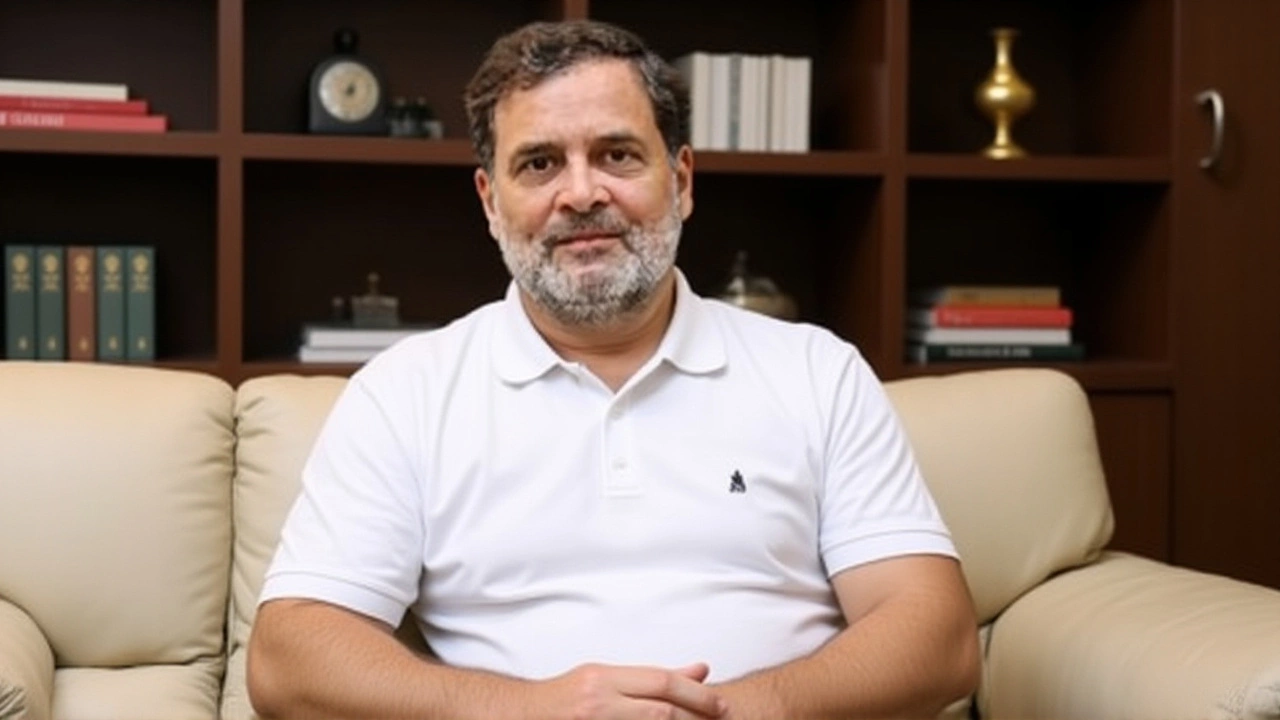
When Rahul Gandhi, Leader of the Opposition in the Indian National Congress, stepped out of Parliament House earlier this week, he didn't just offer a routine critique. He delivered a stinging indictment of the current administration, declaring that running the country is no longer within the capacity of Prime Minister Narendra Modi. The statement, made amidst rising inflation and global economic uncertainty, has ignited a fresh firestorm in New Delhi’s political arena.
Gandhi’s remarks were not merely rhetorical flourishes; they were specific accusations about governance failure. Standing before a scrum of reporters outside the Parliament House, New Delhi, he argued that the government has shifted its responsibilities onto the public for over a decade. "The state is telling people what to buy, what not to buy, where to go, and where not to go," Gandhi said. "This is not leadership; this is an admission of defeat." ## The Core Accusation: A Shift in Responsibility Here’s the thing: Gandhi’s argument hinges on the idea that when a government starts issuing detailed advice on personal consumption habits, it signals a loss of control over macroeconomic stability. He pointed to several recent appeals from the Prime Minister’s office—urging citizens to avoid buying gold, reconsider foreign travel, and exercise restraint in spending—as evidence of this trend. According to Gandhi, these are not moral lessons but symptoms of policy failure. "In the last 12 years, the country has been brought to a point where the government must instruct citizens on basic economic decisions," he stated. He labeled Modi a "compromised Prime Minister," suggesting that external pressures or internal compromises have weakened the executive's ability to govern effectively. This is a sharp departure from typical opposition rhetoric, which usually focuses on corruption or inefficiency. Here, the claim is about fundamental incapacity. ## The BJP’s Sharp Rebuttal But wait—the ruling party wasn’t going to let this slide. Amit Malviya, head of the Bharatiya Janata Party (BJP)'s IT cell, launched a swift counterattack on social media. Malviya, known for his aggressive digital campaigning, turned Gandhi’s logic against him. Malviya asked a pointed question: If asking citizens for cooperation during tough times is proof of failure, then was India’s first Prime Minister, Jawaharlal Nehru, also a "compromised leader"? Nehru frequently appealed to the public for austerity and sacrifice during the early years of independence. Malviya’s tweet went viral, framing Gandhi’s criticism as historically ignorant and politically hypocritical. "Congress sees citizen participation as failure," Malviya wrote. "Democracy requires shared responsibility." ## Context Matters: Global Turmoil Meets Local Politics The timing of this exchange is crucial. It comes at a moment when West Asia is grappling with geopolitical tensions, affecting oil prices and global supply chains. Inflation in India has remained stubbornly high, particularly in food and fuel sectors. For many households, the cost of living has become a daily struggle. Gandhi’s comments tap into this widespread anxiety. By linking government appeals to economic hardship, he’s attempting to reframe the narrative: instead of seeing frugality as patriotic, voters should see it as a sign that the government hasn’t done its job. This is a risky strategy. It could resonate with frustrated voters, or it could backfire if seen as dismissive of genuine national challenges. ## Historical Echoes and Political Polarization This isn’t the first time Gandhi has used such language. Over the past few years, the Congress party has consistently attacked the Modi government on issues ranging from unemployment to institutional autonomy. But calling the Prime Minister "compromised" adds a new layer of severity. It implies not just poor performance, but a breach of trust or integrity. Interestingly, this mirrors debates from decades ago. During the Emergency period in the 1970s, critics accused Indira Gandhi of compromising democratic norms. Today, the roles seem reversed, with the opposition accusing the incumbent of similar failings. The polarization between the BJP and Congress has deepened since 2014, making such confrontations almost inevitable during parliamentary sessions. ## What’s Next for Indian Politics? So, where does this leave us? The immediate impact is likely to be more heated exchanges in Parliament and intensified social media battles. Both parties are preparing for upcoming elections, and every statement is being scrutinized for electoral advantage. Experts suggest that while Gandhi’s words may energize his base, they won’t necessarily sway undecided voters unless backed by tangible policy alternatives. Meanwhile, the BJP will continue to portray the opposition as negative and disconnected from ground realities. The real test will come when economic indicators show improvement—or worsen—in the coming months.
Frequently Asked Questions
What exactly did Rahul Gandhi mean by calling Modi a 'compromised PM'?
Gandhi used the term to suggest that Prime Minister Narendra Modi’s decision-making is influenced by external pressures or internal compromises, weakening his ability to govern independently. He argued that frequent appeals to citizens for financial restraint indicate a lack of effective economic management rather than leadership.
How did the BJP respond to Rahul Gandhi's comments?
Amit Malviya, head of the BJP’s IT cell, countered by comparing current government appeals to those made by former Prime Minister Jawaharlal Nehru. He argued that asking citizens for cooperation during difficult times is a normal part of democracy, not a sign of failure, and criticized Gandhi’s stance as historically inconsistent.
Why is this debate happening now?
The comments came amid rising inflation in India and geopolitical instability in West Asia, which has affected global markets. With economic pressures mounting, opposition leaders like Gandhi are using these conditions to criticize the government’s handling of the economy and its reliance on public austerity measures.
Will this affect upcoming elections?
While direct impact is hard to predict, such statements aim to shape voter perception ahead of future polls. The Congress party hopes to frame the BJP as ineffective, while the BJP seeks to portray the opposition as overly critical and lacking constructive solutions. Voter sentiment will depend heavily on actual economic improvements.